


Technology Preserves the Light of Memory: Exploring a New Era of Non-Pharmacological Cognitive Training
Amidst the global trend of population aging, Alzheimer's disease and other forms of cognitive impairment have become an increasingly severe public health challenge. It not only erodes patients' memory and cognitive abilities but also imposes a heavy emotional burden on countless families. Traditionally, drug interventions have been a primary approach, yet the search continues for safer, more fundamental, and more interactive preventive and supportive interventions. Today, we turn our attention to a cutting-edge technological solution-memory training devices based on brain-computer interface technology. With its unique appeal, this innovation is opening a new door to brain health management.
Starting with the Mind: Understanding the Importance of Cognitive Training
Our brain, like other muscles in the body, follows the principle of "use it or lose it." Continuous learning and mental exercises promote connections between neurons, enhancing the brain's plasticity. The core purpose of cognitive training is precisely to activate and strengthen our brain functions through targeted "mental gymnastics," particularly in key areas such as memory, attention, calculation, and orientation. This non-pharmaceutical intervention aims to advance the frontline of cognitive health, emphasizing prevention and practice. It helps the general public-especially middle-aged and elderly individuals, as well as high-risk groups experiencing cognitive decline-maintain brain vitality and youthfulness.
Technology Empowerment: How Brain-Computer Interfaces "Exercise" the Brain?
Have you ever imagined controlling objects in a virtual world with just your thoughts? This is no longer a scene from science fiction movies, but a reality brought about by brain-computer interface technology. The memory training devices mentioned in this article represent an outstanding application of this cutting-edge technology.
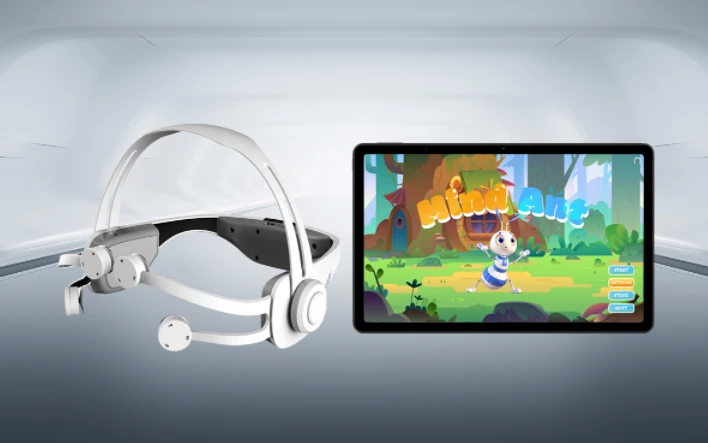
Its operating principle can be simply summarized as follows: When the user wears the lightweight device, it precisely collects and analyzes brain signals generated by the prefrontal cortex. This region is closely linked to our higher cognitive functions, such as working memory, decision-making, and attention control. The device uses sensors to capture the brain's subtle electrical activity in real time during thinking, recollection, and concentration, converting it into commands that control games or training programs.
This enables users to accomplish various tasks on screen without manual input-simply by focusing their attention, recalling memories, or engaging in thought. For instance, users can levitate a virtual ball through pure thought or guide a cartoon character through a maze using concentration. This "mind-over-matter" process itself serves as highly efficient cognitive training, directly targeting neural activity to enhance neuronal responsiveness and promote the restoration and strengthening of cortical functions.
The Outstanding Features of Innovative Devices: Why Do They Stand Out?
Overall, these modern cognitive training devices integrate multiple user-friendly and scientifically grounded design principles, setting them apart from traditional training methods:
1.Non-pharmaceutical intervention, safe and reassuring: Fundamentally avoids potential side effects of medication, offering a new option for users eeking natural, safe intervention solutions.
2.Gamified Interaction, Engaging Fun: Transforms tedious training tasks into vivid animated game interfaces. This design significantly boosts user engagement and adherence, turning brain training from a daunting challenge into an anticipated daily activity. The essence of this device's design lies in effortlessly enhancing cognitive abilities through enjoyment.
3.Personalized Programs, Tailored to Your Brain: The device generates customized training plans based on each user's initial EEG signals and training performance. This tailored approach ensures training intensity aligns with individual capabilities, maximizing effectiveness while avoiding the pitfalls of one-size-fits-all solutions.
4.Portable Design, Anytime, Anywhere: Its compact, lightweight construction breaks free from spatial and temporal constraints. Users can easily utilize it at home or even while traveling, seamlessly integrating brain health management into daily life.
5.Traceable Results, Data-Driven Management: The device comprehensively records data from each training session, including improvements in brainwave patterns and game scores. This allows users and their families to clearly and intuitively track progress and outcomes, providing positive reinforcement for sustained commitment. According to relevant clinical research data, its intervention effectiveness has reached an encouraging level.
What tangible improvements can training deliver?
Through systematic training, users can expect enhancements across multiple cognitive dimensions:
Enhanced memory: Particularly in short-term and working memory capacity, helping reduce "forgetfulness" in daily life.
Improved focus: Strengthens sustained attention, boosting efficiency in work and study.
Relief from mental fatigue: Offers alleviation and regulation for neuropsychological fatigue caused by prolonged mental exertion or stress.
Enhanced overall cognitive function: Comprehensive training exercises foundational cognitive abilities including logical reasoning, spatial orientation, and language expression and comprehension.
Comparative EEG analysis reveals improved orderliness and activity in brain electrical signals post-training, providing objective physiological evidence for subjective improvements.
Looking Ahead: A New Chapter in Smart Healthcare and Proactive Wellness
Devices integrating biofeedback, brain-computer interfaces, and artificial intelligence represent a pivotal shift in future health management-transitioning from "passive treatment" to "proactive prevention." This approach empowers individuals to become primary stewards of their own health, actively managing their brain wellness. As technology advances and becomes more accessible, we have every reason to believe that increasingly intelligent, home-based health management tools will enter ordinary households, contributing to the development of a more resilient and healthier aging society.