

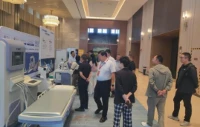


The National Key Research and Development Program project in which HSAP is participating was officially launched at Hebei University
On March 15, the kickoff meeting for the National Key R&D Program's Strategic Science and Technology Innovation Cooperation Project-"Research on an Early Screening and Intervention System for Alzheimer's Disease Based on Non-invasive Brain-Computer Interfaces and Its Validation"-was held at Hebei University. The project is led by Professor Liu Xiuling of Hebei University, with participation from Qinhuangdao HSAP Medical Systems Co., Ltd.

More than 50 people attended the meeting, including relevant officials from the Hebei Provincial Department of Science and Technology, university leaders and heads of relevant departments from Hebei University, experts from the project team, key team members, and representatives from participating research institutions. Song Fengxuan, Member of the Standing Committee of the Party Committee and Vice President of Hebei University, attended the meeting and delivered opening remarks.

In his remarks, Song Fengxuan, on behalf of the university, welcomed the attending leaders, experts, and colleagues from partner institutions. He outlined the university's efforts in recent years to align with major national strategic needs and to continuously advance organized research and interdisciplinary integration. He stated that, as the lead institution for the project, Hebei University would earnestly fulfill its primary responsibilities by providing robust support in areas such as organizational coordination, logistical support, resource allocation, and service management, thereby ensuring the project is implemented to high standards and progresses with excellence.

Zhao Shuhai, Senior Researcher at the International Cooperation Division of the Hebei Provincial Department of Science and Technology, outlined requirements regarding project organization and implementation, collaborative research, task execution, and standardized management. He urged the project team to further strengthen their sense of responsibility, adopt a goal-oriented and problem-oriented approach, and coordinate efforts to advance key technological breakthroughs, system integration, and validation and application, thereby ensuring that research tasks are effectively carried out and yield tangible results.


Liu Xiuling, Member of the Standing Committee of the Party Committee and Vice President of Hebei University, delivered a systematic report on the project's overall objectives, research scope, implementation strategy, task allocation, and schedule. Representatives from participating institutions-including Beijing Normal University, Beijing Institute of Technology, the Institute of Automation of the Chinese Academy of Sciences, Xuanwu Hospital of Capital Medical University, and HSAP-each presented reports tailored to their respective responsibilities, covering technical approaches, research plans, organizational management, and risk mitigation. These presentations helped further clarify the priorities and direction for future collaborative efforts.

Li Xiangdong, Vice President of Research and Development at Qinhuangdao HSAP Medical Systems Co., Ltd., outlined the company's technological breakthroughs and equipment applications in early-stage Alzheimer's disease (AD) screening, intervention training, and therapeutic rehabilitation, leveraging technologies such as brain-computer interfaces, neurofeedback, and pulsed magnetic stimulation.
As a leading domestic manufacturer of full-lifecycle mind-body health management devices, Huisiamp leverages core technologies such as bioimpedance, bionic pulsed magnetic resonance, and brain-computer interfaces to specialize in the precise prevention and treatment of neurological diseases. Its independently developed ADDS Cognitive Impairment Screening System and ADTS Memory Impairment Training System have achieved nationwide clinical application coverage across multiple provinces and cities. Specifically, the ADDS system integrates authoritative scale-based screening with dynamic EEG monitoring, combined with proprietary AI deep learning algorithms, to rapidly perform quantitative assessments across six major cognitive dimensions, accurately screening for the risk of cognitive impairment, including early-stage AD. The ADTS system, meanwhile, utilizes non-invasive brain-computer interface technology to control the progression of rehabilitation games through thought-controlled commands, delivering multidimensional cognitive training to prevent further memory decline. The "ADDS screening + ADTS training" equipment combination forms a comprehensive "assessment-training-reassessment" cognitive health maintenance model.

The project team experts included Researcher Wang Changyong from the Academy of Military Medical Sciences, Professor Hu Bin from Beijing Institute of Technology, Professor Li Zengyong from the National Rehabilitation and Assistive Technology Research Center, Researcher Hou Zengguang from the Institute of Automation, Chinese Academy of Sciences, and Associate Chief Physician Han Yongzheng from Peking University Third Hospital, and Chief Physician Wang Ran from the First Hospital of Hebei Medical University, listened attentively to the project team's report. They posed questions and conducted reviews regarding the project's overall plan, key technical approaches, coordination mechanisms, quality control, and the consolidation of results, and offered targeted and constructive suggestions.


As a participant in this national-level project, HSAP is primarily responsible for the research, development, and system integration of a collaborative intervention system that combines brain-computer interfaces (BCIs) and transcranial magnetic stimulation (TMS). The company will incorporate its proven technological products and clinical experience into the project's R&D efforts to facilitate the optimization and upgrading of multimodal screening technologies and the validation of personalized intervention paradigms. Furthermore, HSAP will continue to increase its R&D investment in the fields of brain-computer interfaces and the prevention and treatment of neurological diseases, deeply integrating cutting-edge technologies such as artificial intelligence and neuromodulation to continuously refine the end-to-end product cycle of "screening -intervention-rehabilitation" product ecosystem. By leveraging original technological innovations to address the challenges in the prevention and treatment of Alzheimer's disease, the company aims to provide robust technical, equipment, and model-based support for the establishment of a nationwide network for the prevention and control of cognitive health in the elderly.
